Before a VPN connection can start working, your device and the remote server first need to establish a connection. This initial exchange of data is called a handshake.
In heavily restricted networks, filtering systems may inspect this initial traffic and try to identify or block certain types of connections before they are fully established.
Handshake Fragmentation, available in Trust.Zone VPN V2, changes how this initial connection data is sent. Instead of sending it as one larger block, the app splits it into smaller fragments.
 Why Fragment the Handshake?
Some censorship and filtering systems use Deep Packet Inspection (DPI) and other traffic analysis methods to recognize connection patterns. If the system identifies traffic it wants to restrict, the connection may be blocked, reset or simply fail to establish.
Fragmenting the initial data can make these patterns harder for some filtering systems to recognize correctly. The VPN server still receives the information it needs, but it arrives in smaller pieces rather than in the usual form.
The goal is simple: help the VPN connection establish successfully on networks where normal connections may be filtered or disrupted.
Handshake Fragmentation is mainly useful on restrictive networks. Typical situations include:
In these situations, enabling Handshake Fragmentation may help establish a more reliable connection.
The feature can be particularly useful in countries where internet providers use advanced filtering systems to control access to websites, apps and VPN services.
Russia is one example. VPN protocols and encrypted connections may work differently depending on the ISP, mobile operator and current filtering methods. A connection that works normally today may later become unstable or fail on a particular network.
Iran and other highly censored regions use similar forms of network filtering, where encrypted traffic can be inspected or disrupted during the early stages of a connection.
Handshake Fragmentation gives Trust.Zone V2 another way to deal with these restrictive network conditions without requiring the user to change how the whole VPN works.
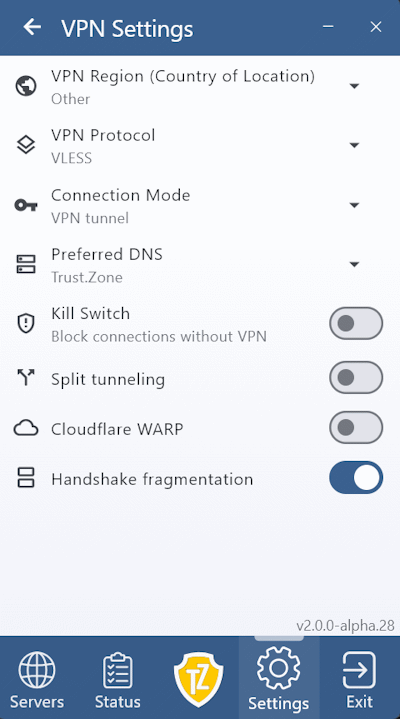 Handshake Fragmentation is built into Trust.Zone VPN V2. If you are having trouble establishing a VPN connection on a restricted network (Russia, Iran, China or other regions), enable the Handshake Fragmentation option in the app and reconnect.
Go to Settings -> VPN Settings -> Handshake Fragmentation
You can download the latest Trust.Zone VPN V2 and use Handshake Fragmentation together with modern connection protocols available in the app.
Note: For Russia, China, Iran, and some other countries, we also recommend selecting the appropriate region under Settings → VPN Settings → VPN Region. If you still have trouble connecting, try changing the VPN Protocol or Preferred DNS provider, or enable Cloudflare WARP.
Usually, no.
If Trust.Zone connects normally and your network does not restrict VPN traffic, there is generally no reason to enable fragmentation just for the sake of it. The feature is most useful when a normal connection has trouble getting through a restrictive or heavily filtered network.
It is another feature available in Trust.Zone VPN V2 for situations where simply connecting to a VPN is no longer as simple as pressing the Connect button.