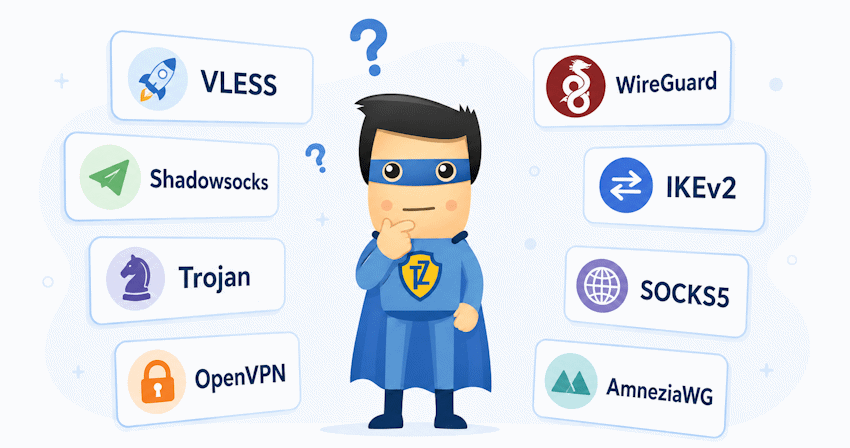
Trust.Zone offers several ways to establish a secure connection, from well-known VPN protocols such as OpenVPN and WireGuard to newer connection technologies such as VLESS, Shadowsocks and Trojan, which are especially useful on networks where standard VPN traffic may be detected, filtered or blocked. But more options also mean one obvious question: which one should you use?
There is no single protocol that is best for every situation. Some focus on speed and compatibility, while others are particularly useful in countries and networks where standard VPN connections are restricted. It is also worth noting that not everything in this article is technically a VPN protocol. SOCKS5 and Shadowsocks, for example, are proxy technologies. For most users, however, the more useful question is what each option does and when it makes sense to use it.
VLESS is a lightweight connection protocol designed to work efficiently across different network conditions. It is especially useful in restricted networks where traditional VPN traffic may be difficult to establish. VLESS can work with connection methods designed for environments with active network filtering, which makes it a practical option when standard VPN protocols are detected or blocked.
This makes it particularly useful in countries with strong internet censorship, such as Russia, Iran and other regions where VPN traffic is actively filtered or restricted.
VLESS is built directly into Trust.Zone VPN V2, so you can switch to it directly in the app. When to use it: for everyday VPN use or when connecting from restricted networks where traditional VPN protocols may be filtered or blocked.
Shadowsocks is not a traditional full-device VPN protocol. It is an encrypted proxy technology designed to work well in networks where internet traffic is filtered. Its main strength is the ability to transport traffic in a way that can be more suitable for restrictive network environments than conventional VPN protocols.
Shadowsocks is supported directly in Trust.Zone VPN V2, alongside VLESS and Trojan. When to use it: when regular VPN connections are blocked, unstable or unreliable, particularly on networks with active censorship or traffic filtering.
Trojan is another connection technology designed with restrictive networks in mind. It uses TLS, the same security technology widely used for normal HTTPS connections. This can make it useful when a network actively analyzes encrypted traffic and tries to identify VPN connections.
Like VLESS and Shadowsocks, Trojan is built into Trust.Zone VPN V2. When to use it: on heavily filtered networks or when conventional VPN protocols have difficulty connecting.
OpenVPN is one of the longest-established VPN protocols. It is mature, highly configurable and supported by a wide range of operating systems, routers and third-party VPN clients. Its broad compatibility still makes it useful, especially for manual configurations and devices where other connection methods may not be available.
Trust.Zone provides OpenVPN configuration files for manual setup. When to use it: when compatibility matters, when configuring a router or third-party VPN client, or when you need a widely supported VPN connection.
WireGuard is a modern VPN protocol designed to be lightweight and efficient. Its relatively simple design has made it a popular option across many operating systems and VPN applications. WireGuard itself is not designed to disguise its traffic from systems that actively identify VPN protocols, so another connection method may work better on highly restricted networks.
Trust.Zone provides WireGuard configuration files through its Setup section. When to use it: when you want a lightweight modern VPN connection and your network does not actively interfere with WireGuard traffic.
IKEv2 works together with IPsec to establish and maintain a secure VPN connection. It is supported natively by many operating systems and is particularly well suited to mobile devices because it can recover quickly when the network changes, for example when switching between Wi-Fi and mobile data.
Trust.Zone supports IKEv2 on iOS compatible devices, including iOS through the Trust.Zone Classic app or manual iOS configuration. When to use it: on iPhone and other supported mobile devices, particularly if you frequently move between Wi-Fi and mobile networks.
SOCKS5 is a proxy protocol rather than a VPN. Instead of creating an encrypted VPN tunnel for the whole device, it can route traffic from a particular application through a proxy server. This is useful when you want to configure a proxy inside one application rather than change the connection for everything on the device.
It is important to remember that SOCKS5 does not provide VPN encryption by itself. Trust.Zone provides authenticated SOCKS5 proxy servers through its Setup section. When to use it: when a particular application supports SOCKS5 and you want to route only that application's traffic through a proxy.
AmneziaWG is based on WireGuard but changes some of its traffic characteristics to make identification by certain Deep Packet Inspection systems more difficult. Trust.Zone provides AmneziaWG configuration files as an additional connection option.
When to use it: as an alternative WireGuard-based configuration, particularly on networks where standard WireGuard connections do not work reliably.
The right option depends more on your network and device than on which protocol is newest.
If your current connection works well, there is usually no reason to keep switching protocols. Changing the connection method becomes most useful when the VPN cannot connect, becomes unstable, or you move to a network with different restrictions. In heavily censored regions, the best option may also change over time, and a protocol that works well with one ISP may behave differently on another network.
If connection problems continue, Trust.Zone also offers additional tools such as Handshake Fragmentation and Cloudflare WARP that can help in difficult network conditions.
Trust.Zone also provides several additional connection options for devices and configurations that require them:
These options are useful for compatibility, while most users can start with one of the modern connection methods described above.
The best choice is the one that works reliably on your current device and network. VLESS, WireGuard or IKEv2 can all be suitable for normal use, while VLESS, Shadowsocks and Trojan become especially useful when the network actively filters VPN traffic. If one connection method does not work with a particular ISP, device or network, switching to another may be enough to restore a stable connection.